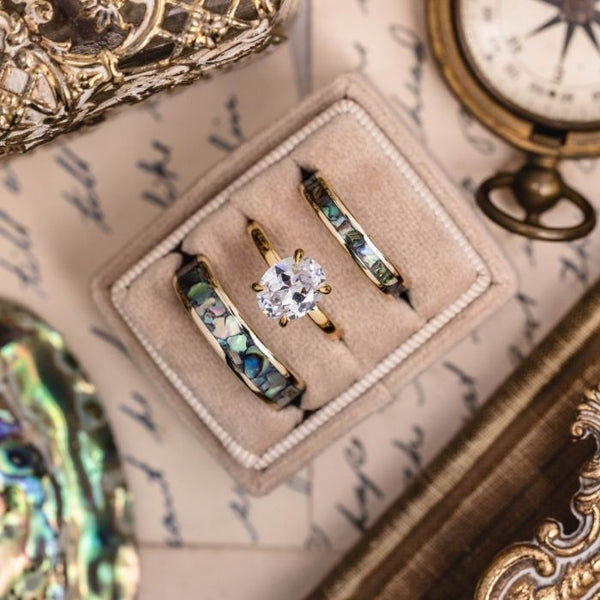
Round
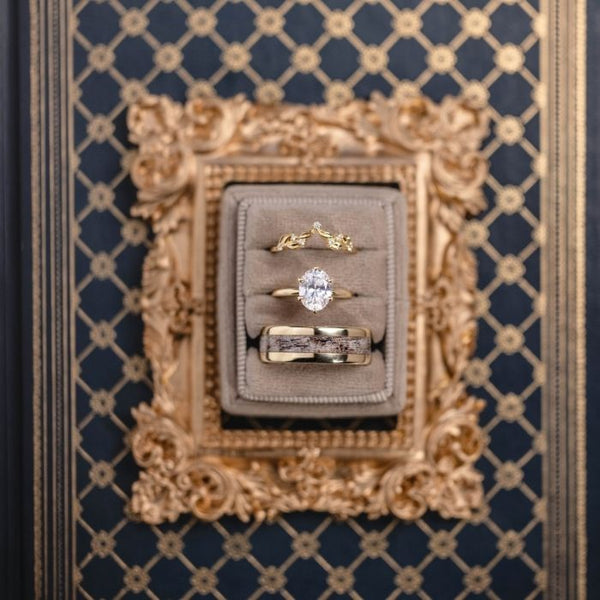
 Oval
 Emerald Cut
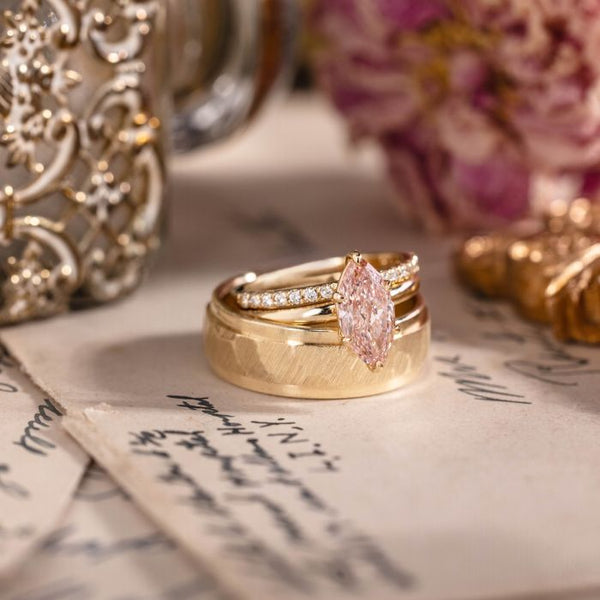
 Marquise
 Pear
 Rose Cut

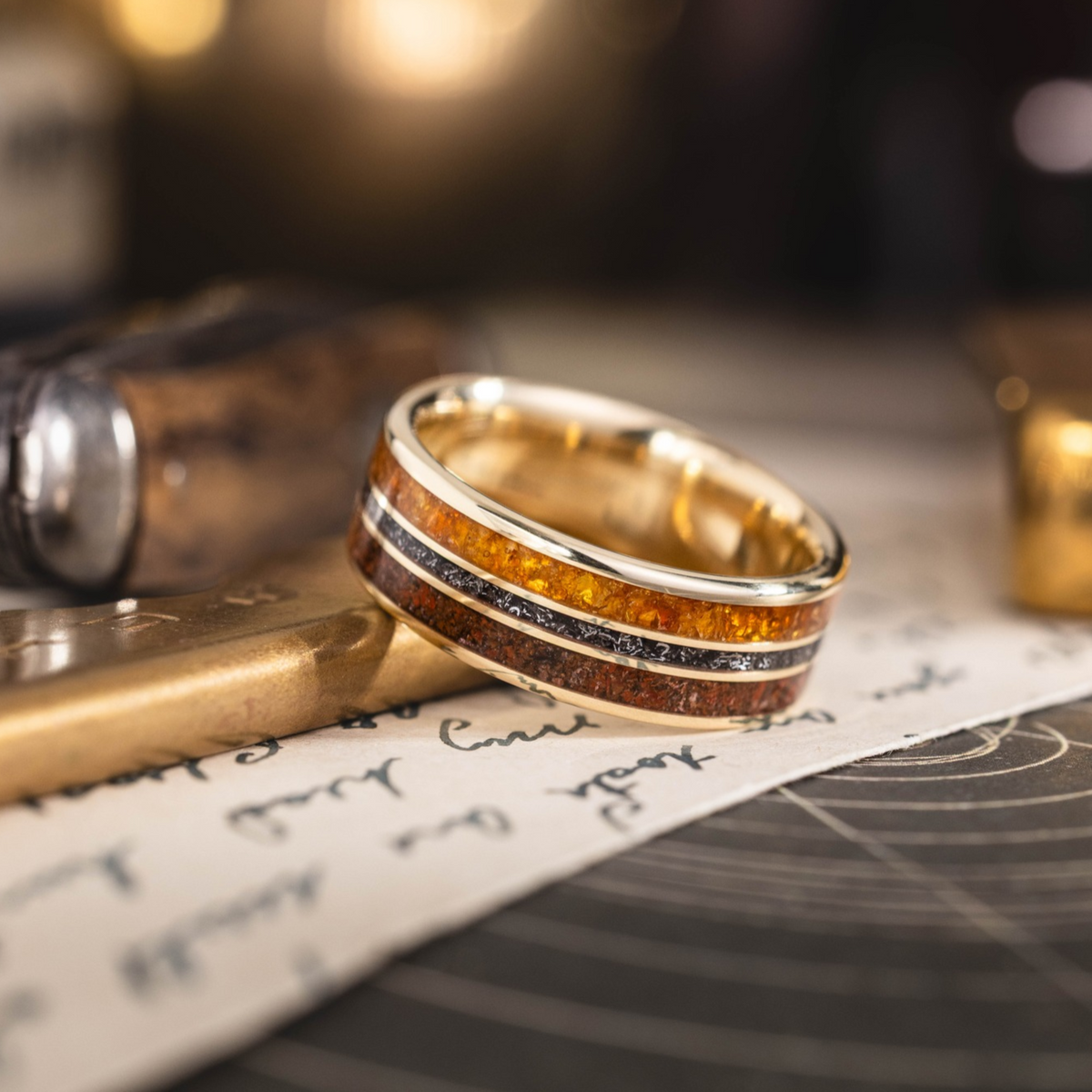
For custom wedding bands, nothing makes more of a statement than your inlay. You might be starting off from a gorgeous gold or titanium base, but that inlay, right there in the center? That’s your story. That’s an intimate sliver of your life – whether it be fabric, wood, or another material – that’s putting your story out on display.
There’s no shortage of ways to tell that tale, but there are inlays that do it better than others; and there’s only ever a couple that will, quite literally, make the final cut. And that’s why this whole process can become intimidating.
That’s also why we’ve put together a guide to custom ring inlay materials.
What Works? What Doesn’t?
You’re not alone in choosing a custom inlay; on top of this guide, we have a full support team that’s helped individuals and couples pick out their materials, refine their design, and craft something exquisite time and time again. If you’re ready to begin that journey, we’d love to walk you through it.
We’ve also been in the business long enough to know what works and what doesn’t work. Rustic & Main is built off the dedication of artists who’ve spent years wrangling raw materials into timeless articles of self-expression. It’s those very same craftspeople who’ve put together a list of our top seven inlay materials (that’s right, we went to the source). In the end, these materials made the cut:
- Wood
- Fabric
- Seashell
- Sand
- Rock & Semi-Precious Stone
- Cork
- Metal Shavings
Why do these materials work? Broadly, we’re looking for custom ring inlay materials that are tailored to your story, but, on top of that, we’re looking for two things.
Firstly, the inlay material needs to be technically reducible and workable. What does that mean? Well, some materials are always going to be easier to work with than others, but there’s a couple of characteristics that are essential for the crafting process. Things like material volume, size, and/or quantity matter in addition to material dryness (an aged section of lumber will almost always work better than a freshly hewn branch).
Secondly, the inlay material needs to maintain readability under resin. It needs to pop. It needs to wow. The wood grain needs to contrast; the stones need to sparkle, and the fabric patterns need to stand out. Simply put, your inlay still needs to look amazing after careful processing.
We’re also looking for materials that are safe to process (more on that later).
So, let’s take a deeper look and see why these top seven inlays work so well.
Our Top 7 Custom Ring Inlay Materials
Wood Inlays

When we got our start, our wooden wedding rings were crafted entirely from a wooden base; we’ve since incorporated a host of metal bases, but wood’s still remained an essential component to our wedding bands. As an inlay, it’s nearly unbeatable.
On the topic of moving away from wooden bases to wooden inlays, Jeffrey (our Production Manager) noted that, “We’ve been able to preserve the stories behind why the ring exists in the first place. So, while the base of the ring may be gold or silver or titanium now, we still have those components to represent whatever story we need to.”
There’s no shortage of options when it comes to wood … it’s a ubiquitous substrate. In using it, we’ve found that many of our most important memories are tethered to wooden items. Anything from guitars to drumsticks to baseball bats to bridges … the list could go on. But if you’re looking for a wood inlay wedding band that carries an entire history behind it, there’s few materials that work better than a timeless classic.
When it comes to sheer beauty, Hawaiian Koa and African Mahogany were listed among our crafters as absolute standouts for their honey brown colorations and intricate, observable woodgrain.
Fabric Inlays

From Scottish Tartan to WWI infantryman’s wool, fabric’s remained a mainstay custom inlay since the beginning. It’s versatile and simple to work with despite its often-delicate nature. However, clients are usually looking for something specific with fabric inlays.
“Clients aren’t sending it [in] because it has a particular sparkle, like a gem … they’re sending in specifically for sentimental reasons.”
– Jeffrey Payne, Production Manager
That’s not to discount the lovely reds and blues that some dyed fabrics own, but, in general, fabric creates an understated look that pairs well with metallic inlays and deep wooden tones.
All to suggest that, if you’re interested in a custom wedding band with fabric that shows off your familial heritage, a storied uniform, or a precious dress, fabric can be incorporated to stunning effect.
“I made a custom wood ring for a sailor about two weeks ago; he sent in his dress blues and his NWUs. It’s the blue camis that we used to wear. He wanted them both in a ring and the edge to be NCT [North Carolina Teak], so it was basically gonna look like a triple with no metal. I ran each fabric in a center channel parallel to each other. So, you had the dress blue which appeared to be black running down it, and then you had the NWU next to it, [where] you could see the light blues pop off of that, which was pretty cool.”
– El-Don Beasley, Craftsman and US Navy Veteran
Seashell Inlays

Immediately beautiful.
That seems to be the sentiment surrounding seashell inlay rings. Seashells, often scooped up on a beach and sent to us, require little processing to capture the eye. A couple of these inlay materials, such as abalone or orange spiny oyster shells, possess a natural glisten that’s difficult to replicate. They remind us of salt-saturated ocean currents, small beach tidal pools, and of too-long summer vacations.
And we don’t want to limit this category to just seashells. The ocean’s bountiful with materials that look phenomenal as custom inlays; we’d recommend checking out some of our listings for inspiration, but materials such as shark tooth and red coral make consistent appearances.
Sand Inlays

Speaking of the ocean …
Out of every custom inlay on this list, sand might be the easiest to work with … our crafters certainly seem to think so. And, sure, you might not immediately think of sand as an aesthetic bombshell, but, when paired properly (such as with deeply colored wood), it stands out beautifully. Gold flakes, too, pop beautifully in a sand inlay.
But sand’s not just about looking good. As an inlay, it’s one of the best ways to create something personal. The texture is deeply tied to our memories … whether it’s sifting through our fingertips or burning warm against our soles, sand creates an immediate mental tether. And, as such, it’s an easy material for clients to source and ship; we’ve received sand from across the world, from childhood beaches to Icelandic volcanoes. There’s always an interesting story behind it and it’s a tangible, organic material that our clients and crafters keep coming back to.
Also for consideration in this category? Sea glass. If you want a wedding ring crafted from sun-soaked sand, a drifting glass bottle, and the parchment treasure map found therein, we can make that happen.
Rock & Semi-Precious Stone Inlays

Out of any of these inlay materials, this might be the most obvious to incorporate into a ring. Rocks and semi-precious stones might be a staple, but they can also represent unique identities and stories. And we’re no strangers to mixing an abundance of personal geological beauties into our designs.
As an inlay, rocks and semi-precious stones are typically reduced (ground down) and sealed within a channel. Malachite, lapis, and tree agate are amongst the easiest to work with, and we’ve worked extensively with jewelry classics like turquoise and opal. Less common materials in this category – whether they’re from outer space or a time gone by – include meteorite and fossil (which this author considers to be among the very coolest things a person can wear; seriously, put a pterodactyl in your ring).
And if none of those speak to you, rocks and semi-precious stones maintain a complex variety of hues and textures that, once reduced and polished with a bit of mineral oil, manage to retain their character throughout the years.
Our crafters enjoy working with these inlay materials because, even if they’re a bit tricky to work with, rocks and semi-precious stones are extremely varied and keep you on your toes so to speak. Expansive as it may be, this is a rabbit hole we couldn’t recommend diving down enough.
Cork Inlays

Was cork on your list? It’s on ours, simply for its sentimental value and porous qualities. In a cork inlay ring, its classic texture holds up under resin, creating a crackled, organic look.
Our cork is taken almost exclusively from wine bottles which is a shorthand for weddings, special events, and momentous celebrations.
That means cork regularly symbolizes a moment between two people – and it’s this idea that makes it a favorite inlay material.
What does it pair well with? Crafter suggestions included weathered whiskey barrel and black tux fabric. Dark woods like purple-heart and bloodwood also create a visual parallel to the wine bottles the cork might have been taken from.
Metal Shaving Inlays

Finally, if we’re abiding by the rule of cool (and we should), metal shavings might take the cake.
“I’ve used brass rifle casing, helicopter parts, aircraft carrier cables, a lug-nut from the tire of a race car, a piece of a decommissioned ship …”
– Zack McGinnis, Craftsman and Marine Veteran
The list could go on. This isn’t an easy material to craft, with an obtaining process that can include files, power drills, and metal lathes, but the end results are well worth it. And what guy wouldn’t love a ring forged from bullet casings?
Not only do metal shavings have an inherent “shine” to them when reduced, they almost always contain and create unique textures inside their channels. It’s often a pattern that’s tricky to predict, but it further reinforces the unique character of each ring.
Metal shavings are a way to express personal histories and careers. Whether you just like the look, or you’re interested in wearing a bit of automotive legacy on your hand, metal shavings are worth your consideration.
The author would like to note that, though they’re not shaved down, metal guitar strings are an excellent consideration for this category, especially for the musically inclined.
What Didn’t Make the Cut?
We’re used to working with unique materials from rich, layered backgrounds, and we pride ourselves in being able to accommodate client desires; after all, we’re crafting rings that tell your story. But that doesn’t mean every material’s as easy to work with as others, and, over the years, our shop’s learned that some put up more of a fight.
Some, like carbon fiber and molded items, create practical concerns and health risks based on inhalation. And others, like fishing line, sound incredible in concept, but the result can sometimes lack the essential ‘pop’ that every wearer is looking for (not to discount the fish tale behind the line, of course).
A Note on Flower Petals
A common inlay material that didn’t make the immediate list, but is nonetheless still popular, is flower petals. They’re a gorgeous inlay, but the preparation process can be a little more involved than that for other inlays.
Still, we wanted to include some tips, straight from the shop, for clients who might be interested in sending in flower petals for a custom inlay.
- In a well-ventilated area, fill a small container with an inch or two of silica gel crystals.
- Trim your flower petals, choose your favorites, and place them on top of the silica, making sure to avoid overlapping.
- Fully cover the petals in another layer of silica.
- Seal the container, making sure that it’s airtight.
- For small, thin petals, a week of drying out should work; for larger petals with greater moisture content (like roses), two weeks might be required.
- Once dry, gently uncover the petals and remove the silica with a small brush or Q-Tip.

This process not only dries the petals (essential for inlaying), but it also maintains their coloration.
Choosing Your Custom Ring Inlay
At this point, we hope you’ve conjured up a couple of inlay ideas for your own custom ring. If you still need ideas, we’d recommend checking out our inspiration guide or our custom ring designer.
And, if you’re looking for a custom inlay, and you’re unsure if your material is a good fit, please, reach out; our expert team has run the gamut at this point, and we’d love to help you build something meaningful. We’ll even offer tips for preparation, so your inlays get put together as best as possible.
Consider booking a free consultation; your ring’s story might’ve begun a long time ago, but creating it can start today.