Round
Round Oval
Oval Emerald Cut
 Marquise
 Pear
Pear Rose Cut

If you’re trying to figure out how to buy an engagement ring online, take a breath. You’re not behind. You’re not at a disadvantage. You’re just doing what most guys are doing in the modern age: sitting on your couch at 11 p.m. with seventeen browser tabs open, wondering what the heck you’ve gotten yourself into.
Here’s the bottom line. You can absolutely find the right ring online. In a lot of cases, you’ll get more time, more options, and more honest information than you’d ever get standing under a mall jeweler’s spotlight. The trick is knowing what to look for, what to ignore, and where the trustworthy work happens.
This is your online engagement ring buying guide. Less Rings 101, more “how do I not screw this up.” We’ll cover how to spot a real jeweler from a flashy storefront, how to figure out her size without tipping her off, how to read product photos like someone who knows what’s underneath them, how to set a budget that actually fits your life, and what the fine print should look like before you click buy.
The Honest Truth About Buying an Engagement Ring Online
Buying an engagement ring online is not as risky as people think. It’s a little different, with a little more work, but the upside is real.
Are there drawbacks? Sure. You can’t hold the ring before it ships. You can’t see how the gold catches the light or read the salesperson’s face. You’re trusting photos, video, and the jeweler’s word until the box shows up. None of that is a dealbreaker. It’s just the trade-off.
What you get in return is harder to find in a store. You take your time. You compare in detail. You read real reviews. You talk to the people actually making the ring, send back a photo of her hand, and ask, “is this going to look right on her?”
Also, the best online jewelers are not warehouse operations shipping from a mystery location. They’re real workshops with real craftspeople who happen to have a website. The job is figuring out which is which.
Vet the Jeweler Before the Ring
Before you fall in love with a specific ring, fall in love with the jeweler making it. The ring is the product. The jeweler is the long-term relationship: resizing, repairs, the call you make ten years from now when she catches it on a kitchen drawer.
Green flags worth looking for:
- A real address, real workshop photos, real names of the people doing the work. If the “About” page is stock photos and corporate speak, keep moving.
- Reviews on multiple platforms, not just on-site testimonials. Look for reviews that mention how the company handled a problem, not just the unboxing.
- Clear sourcing language. Phrases like “ethically sourced” should come with details, not just be a sticker on the page.
- Made-to-order or handcrafted in a country you can name. “Handcrafted in the USA” should mean you can find a town on a map. Rustic & Main, for example, builds rings in Huntersville, NC, (just outside of Charlotte) with a team of craftsmen and craftswomen you can meet on the website, or even drop by and say hey!
- Real customer service. Email a question before you buy and see how long it takes to get a thoughtful answer. Slow or generic replies tell you what the post-purchase experience will feel like.
Red flags worth running from:
- “Lowest price guaranteed” energy. Ring craftsmanship has a real cost. If a site is competing on price alone, something is being skipped.
- Vague return and warranty policies, or worse, no policy at all.
- A product catalog that’s enormous and changes weekly. That’s a drop-shipper, not a jeweler.

How to Find Her Ring Size Without Blowing the Surprise
This is the part that scares most guys. It shouldn’t. You’ve got this.
You have more options than you think, and most online jewelers can resize the final ring later if you’re close. Your job is to get in the neighborhood, not nail it down to the half millimeter.
A few methods that work:
- Borrow a ring she already wears. Get it sized by a jeweler. Take it back before she notices.
- Ask a friend who knows her. Sisters, mothers, and best friends are usually delighted to help. They’ve often already had this exact conversation with her.
- If she’s into rings already, take the easy route. Compliment a ring she’s wearing, ask where she got it, and casually ask the size. People talk about themselves more freely than you’d think.
And please, please, please avoid the string trick. It feels clever and gives bad numbers.
Here’s the part nobody tells you. Most quality online jewelers, R&M included, build resizing into their warranty. A small size adjustment after the proposal is normal, expected, and not a sign you messed up. Get close, propose with confidence, and worry about the perfect fit on the other side of “yes.” Easy peasey lemon squeezy.

Read Product Photos Like a Pro
Online ring photos are working hard to sell you. That’s not bad. It’s the medium. The trick is knowing what’s being shown.
Look for hand shots. A photo of the ring on a real hand tells you scale. A 1.5-carat stone looks very different on the page than it does on her actual finger.
Look for multiple angles. A trustworthy jeweler shows you the side profile, the underside, the band thickness, the prongs, the gallery. If the only photo is a top-down hero shot, ask for more before you buy.
Pay attention to the stone itself. A good product photo shows the center stone in natural light, not just under a jeweler’s lamp. You want to see how the diamond actually catches light, where any inclusions sit, and how the color reads against the metal. If a stone only ever appears in one carefully staged shot, that’s worth a follow-up question.
Watch the video if there is one. A short clip of the ring rotating under natural light is worth more than a hundred polished stills.
Also. If you can’t tell what something is going to look like in real life, ask. A good online jeweler will send you more photos, hop on a quick video call, or mock something up before you commit.

Diamond, Lab-Grown, Moissanite, or Something Else?
This is where guys get stuck the longest, and it’s usually because they’re solving the wrong problem. The question isn’t “what’s the best stone.” The question is “what would she love.”
Diamonds are the classic. If she grew up imagining a diamond engagement ring, give her the diamond. What she pictured matters more than what a comparison chart says.
Lab-grown diamonds are real diamonds, made in a lab instead of pulled from the ground. Same hardness, same sparkle, same chemistry, often a better price for a bigger stone. If she’s ethics-minded or budget-conscious, this is a strong move. The lab grown vs natural diamond engagement ring conversation has shifted hard over the last few years, and there’s no shame in either choice.
Moissanite is not a diamond, but it sparkles brighter and costs a fraction. Plenty of couples choose moissanite on purpose because they like how it looks, not because they’re settling.
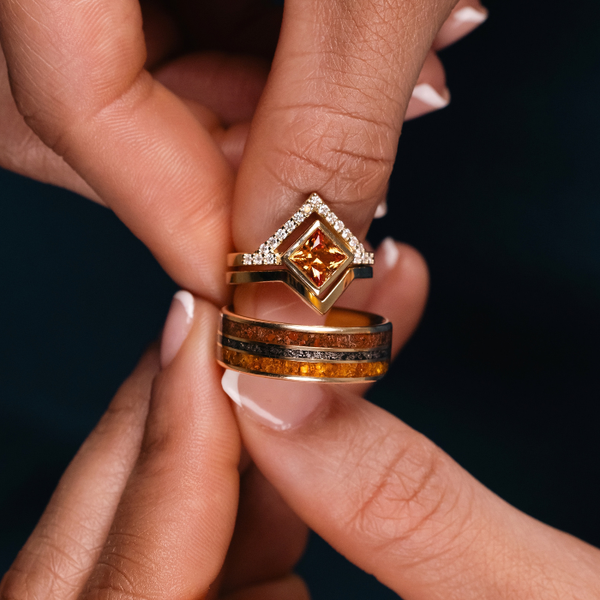
Colored gemstones are having a real moment. Sapphires (which come in way more colors than blue), emeralds, morganite, aquamarine. If she wears bold jewelry, points at the unconventional ring in the magazine, or has a favorite color she keeps coming back to, take that seriously.
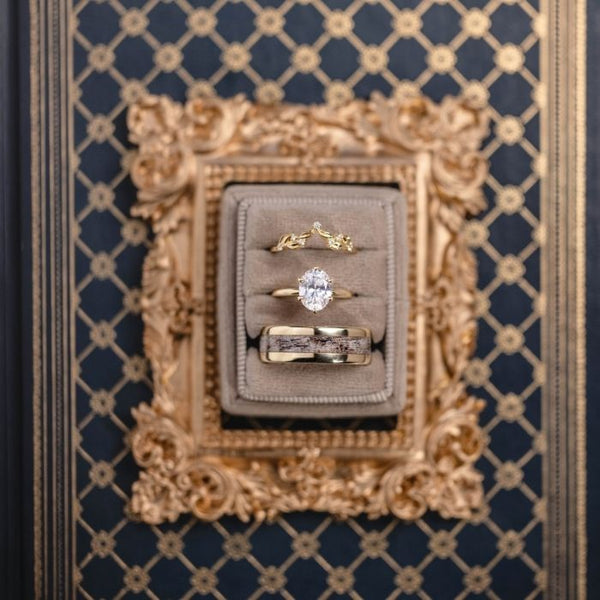
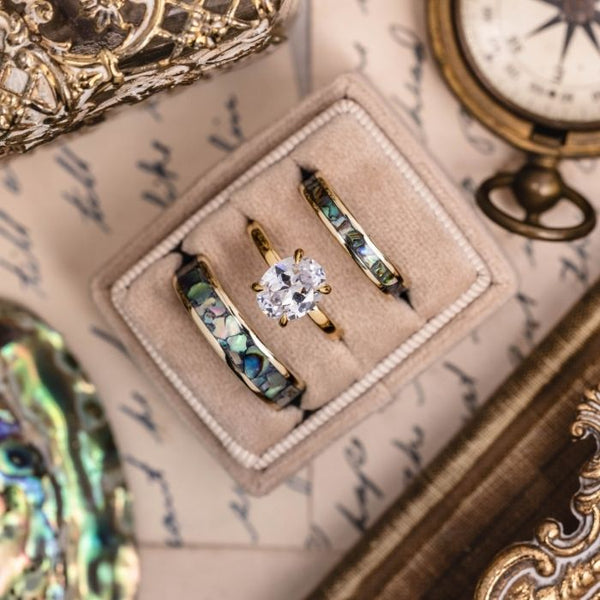
Alternative materials for an inlay band open a different path entirely. Whiskey barrel oak, meteorite, antler, historic wood, guitar string. These tend to land with people who want their ring to carry a story, not just a price tag. Rustic & Main is built around exactly this kind of work, including pieces made from heirlooms and memorabilia customers send in.
Pay attention to her, not the trend report.
Why Certification Matters (and Which Labs to Trust)
Whatever stone you land on, the report that comes with it is what protects you. A diamond certification is a third-party lab’s written opinion on the 4Cs: carat, cut, color, and clarity. It’s how you know the stone you’re paying for is actually the stone you’re getting.
Three labs are worth knowing.
GIA, the Gemological Institute of America, is the gold standard for natural diamonds. The strictest grading, the most consistent reports, and the certification most jewelers and appraisers will trust without a second thought. If you’re buying a natural diamond, ask for a GIA report.
IGI, the International Gemological Institute, is the most widely used lab for lab-grown diamonds. Trusted, accessible, and the standard the lab-grown market runs on. If you’re going lab-grown, an IGI report is fine.
GCAL, the Gem Certification & Assurance Lab, is smaller than the other two but known for measuring light performance: how the stone actually handles brilliance, fire, and optical symmetry. Good for buyers who want a closer look at how a stone will sparkle, not just how it grades on paper.
Whatever you do, don’t buy a center stone of any real size without a report from a recognized lab. A jeweler who shrugs at this question is one to walk away from.
How to Set Your Engagement Ring Budget
The “three months’ salary” rule was invented by an ad agency. Ignore it. The real engagement ring budget question is what fits your life right now, while still getting her something she’ll love.
Most guys land in one of three approaches. There’s no wrong answer. Just pick the one that fits her and the season you’re in.
Prioritize the stone. You want the center stone to do the talking. Bigger carat weight, better cut, higher clarity. The setting stays clean and classic so the diamond is the show. This is a good move if she loves a traditional solitaire or if her style is more “one statement piece” than “lots of details.”
Prioritize the band and the craftsmanship. You want the ring to feel like an heirloom from the moment she puts it on. Detailed metalwork, custom gold work, a sentimental inlay, a setting nobody else has. The stone is still beautiful, just not the only thing she sees. This fits the woman who notices texture, finish, and story over carat weight.
Find the balance. A respectable center stone, a thoughtful setting, no single element trying to be everything. This is where most couples land, and it’s usually the right call if you’re not sure which direction she’d go. Lab-grown diamonds make this approach a lot easier because you can get more stone for the dollar without giving up on the band.
One more thing. Whatever number you land on, leave a little room for the things you can’t see on the spec sheet: sales tax, a sizing adjustment after the proposal, and the wedding band that will eventually sit next to it. A budget that leaves zero margin is a budget that stresses you out.

Going Custom Online: What a Good Virtual Consultation Looks Like
If you can’t find the ring, build it. A custom engagement ring online is not the luxury it sounds like. The overhead is lower, the consultation is built into the workflow, and the result is something nobody else owns.
A good custom ring process online looks like this.
You start with a free consultation, usually a 30-minute video call with a real designer, not a chatbot. You bring inspiration photos, a budget, and anything sentimental you want incorporated. Heirloom diamonds or a piece of memorabilia. R&M regularly builds rings around materials customers send in.
You get a sketch or 3D render before any ring is made. If the jeweler skips this step, push back. You should be able to see what you’re paying for before things get moving.
You get a clear timeline. Most quality custom rings take four to eight weeks. Anything promising 48-hour custom turnaround is not actually custom.
You get a final approval before production. No surprises.
Custom takes longer than picking something off the shelf. The trade-off is that you end up with a ring nobody else has, built around something that means something to both of you. For most guys who go custom, that’s the whole point.
The Fine Print That Actually Matters
Read these four things before you buy. Not some of them. All four.
Returns. What’s the window, and what’s the condition? Most reputable online jewelers offer 14 to 30 days. Check whether the policy covers custom work. Most custom rings can’t be returned for a refund, which is fair, but a good jeweler will work with you on a redesign if something’s off.
Resizing. Free is the standard worth holding out for, especially for the first sizing after the proposal. Some jewelers offer free lifetime resizing on certain materials. Read carefully. Wood, meteorite, and other custom materials sometimes have different resize policies than gold or titanium.
Warranty. Look for a real lifetime warranty on craftsmanship, not just a 30-day defect window. A strong warranty tells you the jeweler stands behind their work.
Care and repairs. Stones loosen. Bands scuff. Life happens. A trustworthy online jeweler has a clear process for ongoing care, often free or low-cost for original buyers.
Also. Look for a written explanation of what’s covered and what isn’t. If the policy reads like a marketing page instead of a policy, ask for a real one before you click.
When to Stop Researching and Just Buy the Ring
At some point, the research starts working against you. You’ll know you’re there when you’ve looked at the same five rings four times in a week and they all look the same.
Here’s a useful gut check. If the jeweler passes the vetting, the ring fits her style, the policy is solid, and the price is in your range, that’s a yes. There’s no perfect ring. There’s the one that fits her, made by someone you trust. That’s the whole checklist.
You’re not going to make her love you more by spending three more weekends comparing prong styles. Pick the ring. Place the order. Go propose.

Your Story. Her Ring.
Buying an engagement ring online is often the better way. Better selection, more honest info, and you actually get to talk to the people making the thing. The risk isn’t the internet. The risk is buying from somebody who doesn’t really make rings.
If you want to talk it through with a real person, Rustic & Main offers a free consultation, virtual or in person at our workshop in Huntersville, NC just north of Charlotte. Bring your ideas, your inspiration photos, or just your questions. The team’s job is to help you tell her story in something she’ll wear for the rest of her life.
You found the right person. The ring part is the easy half. Take your time….just don’t drag it out.